Java Byte Alignment
Generally, Java objects don't require manual byte alignment considerations as the JVM automatically optimizes this during compilation. However, languages like C/C++/C# need careful consideration of object field ordering to avoid wasting space. (Note: This article is based on JDK 1.8)
Object Structure
In the HotSpot JVM, objects in memory are divided into three regions: Header, Instance Data, and Padding.
Object Header
- Mark Word: Contains a series of flag bits, such as lightweight lock flags, biased lock flags, etc. Takes 4 bytes in 32-bit systems and 8 bytes in 64-bit systems.
- Class Pointer: Points to the memory address of the corresponding Class object (its metadata object). Takes 4 bytes in 32-bit systems and theoretically 8 bytes in 64-bit systems (in practice, JVM uses optimization techniques to usually compress the class pointer to 4 bytes).
- Length: For array objects only, there's an additional 4-byte space storing the array length.
Alignment Rules
The 64-bit HotSpot VM reads data in minimum units of 8 bytes, so object sizes must be multiples of 8 bytes, with padding added if necessary.
Experimental Comparison
C/C++
In C/C++, inefficient property ordering in structures can increase the required storage space.
Test Code
x1struct Person1 {2 char _char;3 int _int;4 short _short;5};6
7struct Person2 {8 char _char;9 short _short;10 int _int;11};12
13int main() {14 printf("_person1 sizeof: %d \n", sizeof(Person1));15 printf("_person2 sizeof: %d \n", sizeof(Person2));16}Results
xxxxxxxxxx21_person1 sizeof: 12 2_person2 sizeof: 8 Therefore, arranging structure properties in a reasonable order is crucial in C/C++ programming. Fortunately, the JVM automatically adjusts property order to ensure minimal object storage space.
Java
Test Code
xxxxxxxxxx211public class Person {2    public char _char;3    public int _int;4    public short _short;5}6
7public class Person2 {8    public char _char;9    public short _short;10    public int _int;11}12
13public static void main(String[] args) {14    Person person = new Person();15    String s = ClassLayout.parseInstance(person).toPrintable();16    System.out.println(s);17
18    Person2 person2 = new Person2();19    String s2 = ClassLayout.parseInstance(person2).toPrintable();20    System.out.println(s2);21}
Results
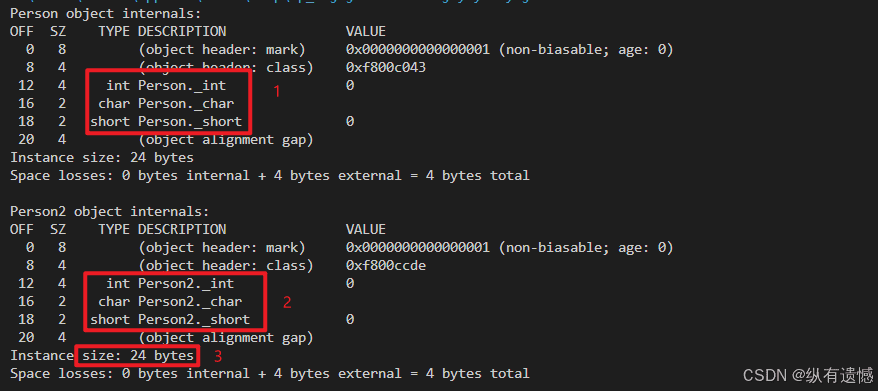
In object memory layout, the JVM optimizes field ordering based on their types and sizes to reduce memory usage and meet alignment requirements. Key observations from the experiment include:
1. Field Order Adjustment: Despite different field declaration orders in Person and Person2 classes, the JVM ultimately adjusts field ordering, prioritizing larger fields (like int _int) to be placed first. This is because:
- Memory Alignment: JVM attempts to combine larger fields with the object header (including Class Pointer) into complete memory blocks (e.g., 8 bytes).
- Padding Reduction: By adjusting field order, smaller fields (like char and short) are combined into the same memory block, minimizing padding bytes.
2. Memory Alignment Rules:
- Field Alignment: JVM aligns fields based on their size - int fields typically require 4-byte alignment, char and short require 2-byte alignment.
- Object Alignment: Total object size is typically a multiple of 8 bytes (for 64-bit systems).
- Padding Bytes: JVM adds padding bytes at the end if the object doesn't meet alignment requirements.
3. Optimization Results for Person and Person2: Regardless of field declaration order, the final memory layout is identical:
- _int is adjusted to the front, forming an 8-byte memory block with the object header.
- _char and _short are combined into the same memory block.
- Padding ensures the total object size is 16 bytes (8-byte aligned).
Additionally, through multiple tests, it's observed that JVM maintains the original property order for fields of the same size during byte alignment, such as long/double, int/float, and byte/boolean pairs.